Start-ups are often associated with "high risk, high reward" — aiming to disrupt a market. They combine agile cultures of new-idea incubation, creative problem-solving, and flat hierarchy. What makes a start-up distinctive is often an innovation-driven approach that leverages fluid collaboration, hands-on experience, and mutual trust.
This article looks at the typical challenges start-ups face when setting up enterprise operations to support their product development ambitions — focusing on the big things to get right early, without boiling the ocean or simply replicating strategies from established rivals.
Engineering start-ups
When it comes to complex engineering, the best-known and most numerous start-ups are currently found in the EV automotive sector: Tesla (arguably not a start-up any more), Rivian, Nio, Faraday Future, Lucid Motors, Proterra, Canoo, Arrival, Rimac Automobili, Lightyear, Volta Trucks. They typically grow by attracting venture capital and other investors — often culminating in an IPO and a transition into a stable, "established" business once they've finished investing in the basics. That maturing into the mainstream is sometimes characterised by the exit of founders.
Getting the basics right in those initial phases can take years for vehicle and aerospace manufacturers, due to complex system requirements, engineering, manufacturing process development, and production industrialisation. Added to product complexity, OEMs in automotive and aerospace lean on third-party engineering and manufacturing partners for component supply. Other important aspects include compliance, safety, cybersecurity, software-and-hardware integration, legislative requirements, and certification. Significant IT and network infrastructure is necessary — but not, on its own, sufficient — to successfully launch products to market.
Complex engineering systems
A "system" refers to a product: a set of components and sub-components interconnected as a "system of systems" and organised purposefully toward a given task. Engineering organisations and OEMs deal with complexity in several interlocking ways:
- Multi-disciplinary product requirements — Designing and managing product and service requirements across the full lifecycle.
- Delivery organisational design — Typically a matrix structure across functions and programmes (product lines), with multi-disciplinary operations managing product change, BOM variant configuration and release, technical and non-technical publications, quality attributes and requirements, simulation results, standards, and compliance.
- From simulation-based to software engineering — Delivering to product design and performance expectations across all embedded functions.
- Functional and technical integration — Integrating support functions into operations based on product scope — IT is now often part of the core strategic business, thanks to the proliferation of vehicle control, management, and infotainment systems.
- Supply chain integration — Implementing outsourcing models to leverage specialist capabilities and economies of scale and scope through supplier engagement — engineering-to-order, configuration-to-order, manufacturing-to-print, etc.
As Mayfield et al. (ENCORE, 2018) highlighted, complexity differs between engineering and engineered systems: "engineering refers to the set of processes and resources that deliver a technical solution, while engineered refers to the outcome of the engineering activity as an assembly of components with certain characteristics."
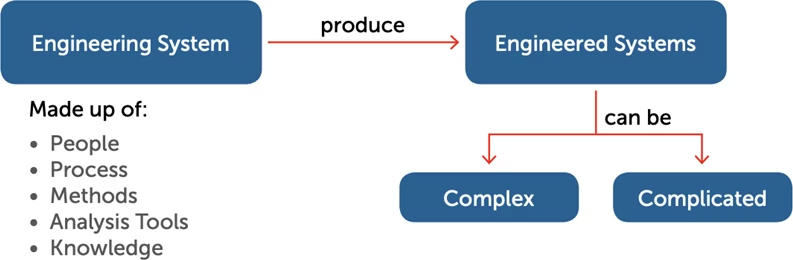
The ENCORE whitepaper makes a further useful point: "an engineered system is created with a specific purpose in mind and deliberately engineered to fulfil that purpose. (…) Complex systems are not fully predictable. Therefore, the engineering of complex systems must take full account of complexity [to] produce systems that can be trusted by society, which is increasingly dependent on such systems."
Nine key challenges faced by engineering start-ups
The challenges faced by complex-systems engineering start-ups aren't dramatically different from those faced by other start-ups — but several are amplified by the inherent product and process complexity and by compliance requirements that result in high barriers to entry, substantial investment needs, and cross-disciplinary talent demands.
- 1. Best athletes — Do we have the right talent, role distribution, and skills? What do we want or need, versus what can we afford? Building a team from scratch requires trust and an understanding of complex requirements — especially when there's no mature business process, organisation structure, or enterprise platform to train new hires on. Onboarding the right talent for the task means hiring the "best athletes" or high performers to stay as lean and nimble as possible.
- 2. Right sizing — When is the right time to introduce an operating process, and how formal or automated does it have to be? Processes can hinder creativity and stifle swift, intuitive decision-making. There's nothing wrong with recognising that certain things will stay broken until the right time to address them — temporary solutions can be sufficient for the next six months, though more robust solutions may be required after that.
- 3. Failing fast — How can we build the required operations without compromising product delivery and cashflow while simultaneously onboarding new talent and investors? There's an ongoing balance between remaining lean and implementing the next enterprise platform to leverage industry best-practice processes. Start-ups need to be ready with the right tools and technologies to jump onto the next step of the maturity ladder — without boiling the ocean or starting too early and losing focus on what really matters. That includes quick iteration and learning from "fail fast" business approaches while mitigating business risk.
- 4. Holistic enterprise architecture — When is the right time to scale, start building the required digital foundation, and how much planning is required for this? Subscribing to online enterprise platforms to get started isn't difficult. Consolidating and integrating those digital tools and processes can be more challenging, especially when data is scattered across multiple sources. Building and managing an ongoing capability-process-integration roadmap is essential — and requires a holistic perspective on enterprise architecture to ensure continuous optimisation and alignment: what data is required by whom, at what point in time, and in what format. Certain things may need to be done twice to put capabilities right for the long run.
- 5. Syncing product and operations — When and how should we get the right team to deliver effective operations? Product and operations strategy often require different talents and owners — to ensure that one isn't compromised at the expense of the other. As start-ups gear up for growth, they have to assess operational readiness and the maturity of operating requirements. A start-up can begin on the right foot with its operating data and digital processes, but it can also rapidly spiral from greenfield to brownfield when faced with the need to transform itself too early — or even before securing the relevant funding tranche for it.
- 6. Not reinventing the wheel — Do we have the right industry connections to leverage partnerships and build new relationships? It makes sense for start-ups to use templates that worked elsewhere in the industry — there's no need to re-invent the wheel. But it's also important not to reproduce the same mistakes, or to aim for an outcome in the short term that established organisations spent years (and millions of dollars) putting right in their own, very different, context.
- 7. Answering a question someone is actually asking — Did we do sufficient market research and competitive analysis to understand how to find the right solution — and how to make a difference in a start-up context? Sizing up opportunities is often perceived as a combined art and science: keeping up with market trends while deciding what could constitute a competitive edge. That includes a sound understanding of business performance, how the business manages change, intellectual property, product development plans, and core resources.
- 8. Not letting data maturity limit product maturity — How and when to build the right minimum viable product (MVP) — and will it be sufficient to demonstrate business potential to prospective investors? Start-ups have changing requirements as they mature and develop their business and associated products or services. It's essential to assess data maturity at least one step ahead of product maturity, so that data doesn't become a drag on growth and the right data is available at the right time.
- 9. Progressive maturity — When do we start investing in infrastructure and enterprise solutions to create foundations for scaling the business? Like data, integrated tools and enterprise platforms need to be implemented at the right time — step by step, without doing too much too early. Approaching change with a progressive-maturity perspective helps drive effective behaviours and outcomes. It's often a compromise between short- and medium-term horizons: starting with limited infrastructure to get the data flowing doesn't mean neglecting the roadmap to connect all the pieces when the time comes.
As Eisenmann (2021) put it: "Doing something new with limited resources is inherently risky. But by recognising that many failures are avoidable and follow the same trajectory, we can reduce their number and frequency. The payoff will be a more productive, more diverse and less bruising entrepreneurial economy."
What are your thoughts?
References
Eisenmann T (2021); Why Start-Ups Fail; Harvard Business Review — adapted from the book Why Start-Ups Fail: A New Roadmap for Entrepreneurial Success, by Tom Eisenmann.
Grealou L (2020); Greenfield vs Brownfield PLM Implementations; engineering.com.
Mayfield M, Punzo G, Beasley R, Clarke G, Jobbins S, Holt N (2018); Challenges of Complexity and Resilience in Complex Engineering Systems; ENCORE Network Whitepaper.