1. Introduction
An engineering change is an alteration made to parts, drawings or software that have already been released during the product design process. The change can be of any size or type; the change can involve any number of people and take any length of time.
Changes become increasingly complex and expensive the later they're made in the development process. An optimised ECM process is therefore crucial for a successful development cycle. Fricke defined five different ECM strategies:
- Less — Reducing the number of engineering changes.
- Earlier (or front-loading) — Early detection and implementation of changes, to minimise the cost of their implementation.
- Effective — Accurate assessment of changes to ensure that they're necessary and beneficial.
- Efficient — Implementing changes by making the best use of resources.
- Better — Reviewing and evaluating changes post-implementation to document lessons learned and best practice.
As COVID-19 illustrated, the automotive industry is becoming increasingly volatile and complex — and the trend is set to continue as manufacturers strive to meet zero-tailpipe-emission targets. That uncertainty, coupled with the rapid technological developments expected in the next 10 years with alternative powertrains and autonomous control systems, means there will be increasing need for state-of-the-art ECM.
Many current ECM systems are designed for robust approval in a slower-paced market — falling into the "Less," "Earlier," and "Effective" strategies. As traditional powertrains disappear, these workflows and systems will need to adapt to meet the demands of a now highly innovative and dynamic industry: pushing toward "Efficient," "Better," and a new Agile ECM strategy. This report outlines some of the industry changes likely to occur within the next 10 years, and how ECM must evolve to fulfil the new and changing demands of the automotive industry.
2. Green mobility
2.1 Zero tailpipe emissions by 2030
Legislation aimed at reducing tailpipe emissions is the main driving force behind the shift from traditional fossil fuels to electric and alternatively fuelled vehicles. Both the UK and EU have set an ambitious target of phasing out the sale of all tailpipe-emitting cars and vans by 2035.
The UK's plan consists of two key steps: the phase-out date for the sale of new petrol and diesel cars and vans has been brought forward to 2030 (hybrid vehicles don't fall under this category); and all new cars and vans must be fully zero-emission at the tailpipe from 2035.
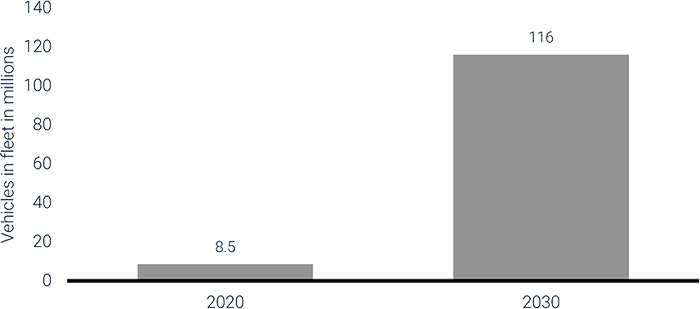
This will force manufacturers to rapidly develop electric powertrains to meet the deadline. In 2020, 29% of car sales in the UK had electrified powertrains — however, only 7% of sales were BEV. That's encouraging for Step 1 of the UK government's plan, which currently appears achievable by 2030. But with only an additional five years to convert 93% of current sales to fully electric (or alternative fuels such as hydrogen), the automotive sector will experience a rapid shift. A PwC report predicts that globally, over 55% of all new car sales will be BEV by 2030, and over 95% of new car sales are expected to be at least partially electrified by 2030 — mapping to a predicted increase from 8.5 to 116 million BEVs globally by 2030.
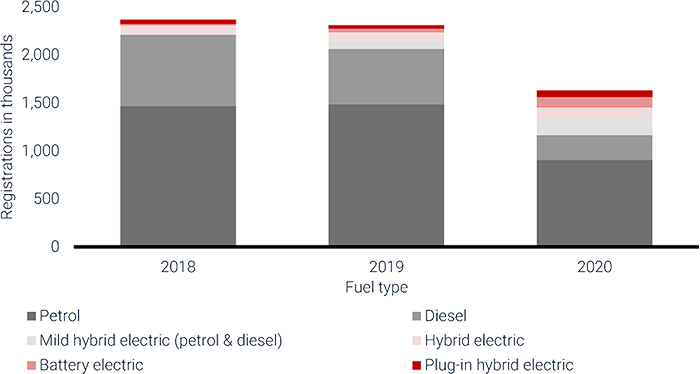
The increasingly rapid shift to battery technology has the potential to put strain on an already struggling supply chain. COVID highlighted risks in the semiconductor supply chain, and there are worsening bottlenecks in the supply of lithium and other raw materials required for battery manufacture. That's driving significant investment in battery R&D, as large OEMs aim to gain more control of the battery supply chain via vertical integration of the production process. Tesla is currently leading the charge, with European OEMs such as VW aiming to catch up — having recently announced major investment into battery manufacture.
ECM implications — green mobility
With rapid development in the EV space expected in the next 5-10 years, ECM will have to adapt to new vehicle architecture. Several EV start-ups have proved successful in this, having had the opportunity to design their ECM from scratch. But large OEMs may struggle to adapt existing processes and tools to significantly different vehicle types. Existing manufacturers will continue to produce petrol/diesel, PHEV, and EV lines in parallel during the 10-year transition. OEMs must choose whether to adapt current systems to work with all vehicle types, or invest in designing and implementing new ECM processes — an opportunity to create more agile, future-proof ECM that can handle increased software integration and IoT devices within vehicle designs more efficiently.
Another ECM consideration: the volatile, rapidly changing supply chain. Rapidly emerging EV technologies — such as Tesla's 4680 tabless cell design — coupled with potential global shortages of EV powertrain components may result in more changes from engineering and procurement throughout the vehicle's lifecycle. An agile ECM system that can facilitate rapid change while accurately estimating impact will be required.
2.2 Paris Agreement and carbon reporting
Alongside legislation driving EV development, green policies such as the Streamlined Energy and Carbon Reporting (SECR) framework are also forcing automotive companies to reflect and act on their own carbon output. Since April 2019, large UK companies have been required to report energy use and carbon emissions as part of their annual reporting. Carbon reporting will continue to increase globally, in an effort to enforce Article Six of the Paris Agreement.
ECM implications — carbon reporting
This will require a new approach to data collection and analysis, including in ECM. Previously the impact of a change was primarily quantified by cost, weight, and the resulting propagated changes within a design. With an increased focus on transparency of carbon footprint and waste, ECM professionals may be required to calculate and report the environmental impact of a new material choice — the impact of scrapping obsolete stock, vehicle efficiency impact, and so forth. That additional consideration during the design-change process will result in increased complexity in ECM. Investment will be required to create workflows and tools to aid increasingly complex impact prediction.
3. Agile in automotive
Software in modern vehicles is rapidly evolving due to innovation in EV and autonomous technology. With the phase-out of traditional powertrains in the next 5-10 years, the automotive industry will see a significant shift toward becoming software-centric. In addition to dealing with increasingly complex software, the race to capture the EV market has put pressure on companies to shorten time to market. In the current market, it's a competitive advantage to develop and innovate software at high pace, as Tesla has illustrated.
As a result, established plan-driven or waterfall development processes cannot serve this sector effectively. Agile development has been established in the software industry for over 20 years, with well-known benefits. By taking an iterative and incremental approach, product development becomes more customer-oriented and able to react to changing market conditions. Adopting agile development strategies is becoming a popular method for tackling the rapidly evolving automotive market, as several EV start-ups have demonstrated.
Arrival, for example, employs agile techniques in its operational structure — distributing in-house manufacture of many components between "microfactories." These deployable microfactories are designed to produce any vehicle line on demand, allowing Arrival to react quickly to changing markets and significantly enhancing its competitive edge. The adoption of agile techniques is clearly advantageous for start-ups that can design manufacturing and workflow processes from scratch — but large OEMs may struggle to replicate this. There are also challenges specific to automotive: accommodating parallel development of hardware and software, and rigorous testing and approval for safety-critical items. This may lead to an automotive-specific definition of agile development as it's adopted more widely by OEMs.
ECM implications — agile
By facilitating increased customer orientation and adaptability to a rapidly changing market, agile processes will increase the workload of ECM. To process a greater number of changes in a reduced time frame, an efficient ECM process is required. Impact-analysis software could be used to empower engineers to make changes with minimal senior-stakeholder engagement. Leaner workflows designed for each stage of development and risk can also help expedite the implementation of engineering changes with minimal resource.
Implementing such a system in an established OEM may come with its own challenges — including integrating with legacy software, robust traditional manufacturing processes, and lack of buy-in from senior stakeholders.
4. Technology driving change
4.1 Autonomous vehicles
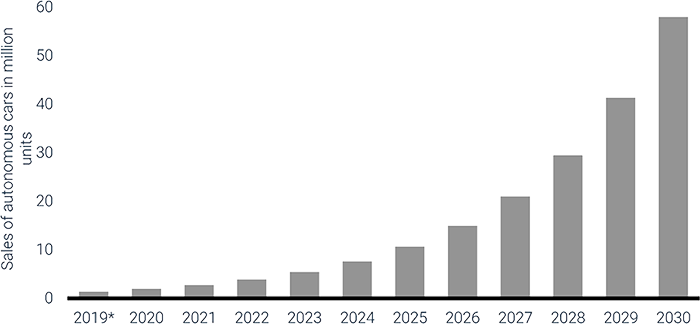
As with electric vehicles, sales of autonomous vehicles are expected to increase rapidly in the next 10 years as supporting technology advances and gains trust from the consumer market. As the autonomous vehicle market grows, it's expected that the adoption of "smart" technologies will increase rapidly — introducing novel concepts such as connected, self-aware vehicle fleets, shared mobility on demand, and internet-connected ECUs providing live data and vehicle insights.
ECM implications — autonomous vehicles
One of the key ECM challenges will be issuing software updates in the field. Although software updates like this aren't new in the computing sector, they're largely new to vehicle manufacture. Many established OEMs don't have change management systems designed for this functionality. Additional complexity arises when software is used across multiple vehicle lines, where integrated software and hardware must be linked. A block-change system may be a solution in this case — at the cost of agility in the process.
With autonomous vehicles, software will play a critical role in passenger safety — and the ECM processes in place must reflect this. ECM will need to strike a balance between agility and rigour to ensure the safety of the final product.
4.2 Novel EV technologies
As with many modern industries, the automotive industry may see a shift toward subscription-based models as opposed to one-time purchase. Technological advances in battery design and IoT connectivity have facilitated the emergence of novel technologies such as Battery as a Service (BaaS). One of the main consumer concerns surrounding BEVs is the cost, maintenance, and lifespan of the vehicle battery — and by offering BaaS, manufacturers hope to eliminate these barriers to widespread adoption.
Last year, NIO, a Chinese-based automotive manufacturer, launched its BaaS service with subscriptions for a 70-kWh battery pack at £110 per month. By opting for the battery subscription, buyers were offered a £7,250 (~$10,000) discount on vehicle purchase. NIO has also invested in battery-swapping infrastructure, so customers can replace discharged batteries — eliminating charge waiting time.
ECM implications — novel EV technologies
Committing to large-scale infrastructure and long-term subscription services places greater pressure on ECM to minimise or eliminate post-production changes that could affect the battery or any ancillary components. Initial change management for design must introduce a new degree of rigour and detailed analysis to ensure this — and incorporate Design for Change (DfC) at an early stage to future-proof the design and supporting infrastructure.
When designing new vehicles, changes must be thoroughly checked to ensure they won't affect swap stations or the interfacing battery design. This may be more akin to procedures adopted in aerospace projects: reduced agility, increased scale and complexity, and a rigorous approval process.
If new battery architecture is required, ECM must be able to calculate the associated impacts — and facilitate this large-scale block change. That includes the impacts on both the vehicle design and the battery-swap network, introducing a new area of expertise that automotive ECM professionals must acquire.
4.3 AR/VR
Augmented reality (AR) and virtual reality (VR) are relatively well-established technologies that are beginning to find their place in the engineering sector — for example as an immersive aid to CAD design, virtual validation, and collaborative design. As this technology becomes more accessible, its use in the engineering space will expand. One of the less obvious applications may be in ECM.
One of the key drivers of engineering change is customer-driven requirements change — more prevalent in bespoke, niche, or luxury vehicle markets, where customer satisfaction is often a top priority. In extreme cases, customers may not finalise requirements until a physical mock-up can be produced — time-consuming, expensive, and inefficient. AR/VR technology can mitigate the need for a physical mock-up, helping customers finalise requirements much earlier in the development phase and at reduced cost. That in turn has the potential to significantly reduce the number of late engineering changes.
The same principle applies to the design process. Engineering VR technology provider Varjo claim that designers can spot more than 80% of the problems that usually go unnoticed when experiencing and modifying projects on a 1:1 scale in an immersive environment. Coupled with enhanced collaborative engineering via VR, this could further reduce the number of design iterations, optimise solutions faster, and reduce the number of ECNs raised throughout the development cycle.
4.4 AI and machine learning
In addition to facilitating the development of autonomous vehicles, AI and machine learning have the potential to significantly improve ECM processes and systems. When an ECN is raised, several impacts must be estimated — cost, weight, supplier impact, change propagation, and potentially environmental impact. In many cases that's estimated manually by the engineer, with more advanced systems using Function-Behaviour-Structure (FBS) linkage ontology, model-based systems, and various other Change Prediction Methods (CPM) to reference similar changes and aid impact assessment.
Applying machine learning to a database of ECNs and resulting impacts could improve impact-assessment accuracy — estimates won't vary with the experience of the individual engineer. Such technology may also be able to predict potential changes by considering incoming legislation, failed simulations, or supply chain issues. This approach has already been investigated in the aerospace industry: a case study indicated that the operational complexity of a service project could be predicted with 70% accuracy using only 30% of the project data, using a machine-learning model.
5. Summary of ECM challenges in automotive
5.1 Green mobility
- Rapid technology development → significant increase in revisions of released designs to expedite development.
- Pressure on supply chain for EV (raw materials for current battery technology, semiconductor chips, etc.) → strain on procurement and increased engineering changes.
- Legislation on carbon/waste reporting → additional impact to consider during the EC process.
5.2 Technology driving change
- The use of AR and VR to help freeze customer requirements earlier and without expensive mock-ups → reduce number of engineering changes during product development.
- Claims that AR and VR can optimise solutions more easily and enable engineers to spot 80% of previously missed errors → reduced strain on ECM.
- Using AI to learn from previous ECNs → more accurate impact and risk assessments.
5.3 Agile in automotive
- Increasingly software-centric → ECM processes will adapt to implement integrated software and hardware changes.
- Agile development strategies → ECM will process a greater number of changes more quickly (lean/agile workflows), while ensuring robust approval for safety-critical elements.
- ECM will have to facilitate post-production block changes of software in the field.
6. ECM in other sectors
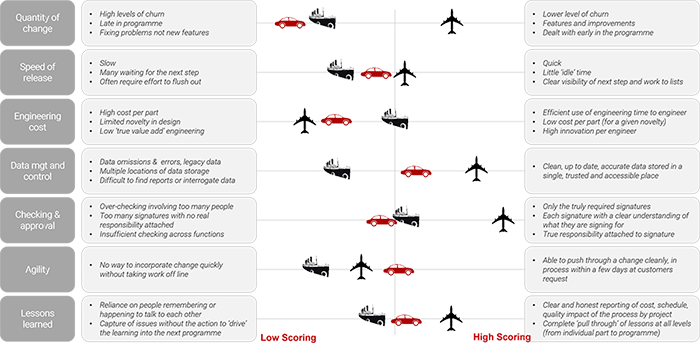
Many of the driving factors behind the changes in automotive are also generating innovation in other spaces. The shift in global consciousness regarding energy sustainability — coupled with increasingly accessible innovative technology — will have a much wider effect than simply the automotive industry. ECM needs can vary quite significantly between sectors. QR_ has benchmarked some of these sectors, including aerospace and defence (maritime), against the automotive industry.
6.1 Energy
The energy sector is expected to "see an unprecedented level of change" both in the immediate future and the coming decade. With innovative consumer items such as electric vehicles rising in popularity, and the closure of all coal power plants by 2025, the sector faces the challenge of decarbonising and decentralising while maintaining a secure power supply.
The shift to decarbonise is a global effort, with legislation such as the Paris Agreement driving change. In this case we'll focus on the UK as an example. The UK government has outlined three main goals for energy supply: decarbonisation, security, and affordability. A report by Arup has highlighted that many solutions will be required to achieve this — and flexibility in system architecture, operation, and regulatory frameworks is essential. In terms of practical steps, the Arup report predicts that the installation of solar and wind will need to triple, with microgrids located at universities or industrial parks potentially providing 34-45% of the nation's generation capacity. That'll create a boom in the development, production, and distribution of green energy generators such as solar panels, wind turbines, and other innovative technologies.
ECM implications — energy
The boom in the green energy sector — coupled with rapid innovation like that seen in the automotive space — will result in the need for more effective engineering data management, including ECM. As new businesses emerge and established engineering companies diversify, there'll be a need for expert consultation regarding the design and implementation of ECM systems.
The manufacture of solar panels and wind turbines shares some similarities with vehicles: production volumes and development lifecycle lengths are of similar magnitude. Although solar panels and turbines may have fewer components than a vehicle, the manufacturing process of components is significantly more complex. Despite that, the knowledge from established ECM systems in automotive could be used to aid the design of critical features such as impact assessment and workflow design — with appropriate stakeholder management.
6.2 Aerospace
ECM in aerospace varies quite significantly from the automotive sector. Aerospace is a heavily regulated, safety-critical industry in which the size of operations and development-cycle timescale are a magnitude larger than automotive — so rigour and meticulous planning are favoured over agility and innovation. The lifespan of a commercial aircraft can be over 30 years, and the industry is slow-moving compared to automotive. The Airbus A320 design has been in production since 1986, with only incremental improvements over the 35-year period.
Despite this, a 2019 report from Airbus predicts that within the next 20 years, a growing global middle class and increased demand for airfreight will create demand for 39,210 new aircraft — including replacing over 14,200 aircraft currently in service, in addition to doubling the global fleet.
The climate change crisis will also force the commercial aerospace sector to change radically in the coming decades. While this is a technical challenge, several innovations are emerging in the sector. In 2021, Rolls-Royce tested its electric-powered prototype Spirit of Innovation. Rolls-Royce claim the advanced battery and propulsion technology developed will help the industry take a step closer to zero emissions.
ECM implications — aerospace
A new wave of innovation in the commercial aerospace sector will generate demand for smarter, more efficient ECM. In addition to rigorous assessment and approval processes, this industry would benefit significantly from accurate concern ageing and cost prediction. Machine-learning models could be used to achieve that, enabling better time-to-market planning and budget control. Machine-learning techniques have been proved successful in predicting characteristics for service projects in aerospace (as mentioned in Section 4.4). Applying this technology to ECM could help predict concern ageing, cost of change, and impact to the product development lifecycle.